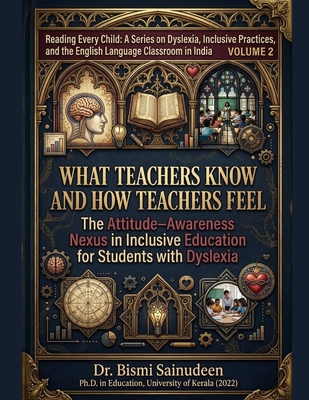
What Teachers Know and How Teachers Feel: The Attitude-Awareness Nexus in Inclusive Education for Students with Dyslexia
What Teachers Know and How Teachers Feel

$12.06
What Teachers Know and How Teachers Feel
What does it take to truly include a child with dyslexia in a mainstream classroom? Not policy. Not goodwill. Not a degree. This volume answers that question with the rigour of doctoral research and the clarity of a scholar who has lived inside the data.
Built on a landmark study of 630 primary school English language teachers across six districts of Kerala, What Teachers Know and How Teachers Feel reveals a finding that challenges everything teacher education has assumed: it is not training in inclusive strategies that most powerfully shapes teacher attitude toward students with dyslexia -- it is knowledge of what dyslexia actually is.
Awareness of dyslexia -- its neurological basis, its phonological processing profile, its independence from intelligence -- had a moderate positive relationship with inclusive attitude. Awareness of inclusive practices alone had only a low positive relationship. This asymmetry is the book's central paradox, and its most urgent lesson.
Inside this volume: Why gender, age, and postgraduate qualification do not predict inclusive attitude -- and what does Why teachers with more than 10 years' experience significantly outperform their junior colleagues on every measure The neurological turn: how understanding the dyslexic brain restructures the teacher's mental model of the struggling reader
The original Attitude-Awareness Nexus Model (AANM-IE) -- a theoretically grounded framework for transforming teacher education Three-level roadmaps for change at the teacher, institution, and policy levels Deep engagement with Ajzen, Bandura, Shulman, Borg, Pajares, Snowling, and the global inclusive education literature
This is Volume 2 of the Reading Every Child series -- a scholarly series on dyslexia, inclusive practices, and the English language teacher in India. It is written for teacher educators, school leaders, researchers, and every teacher who has ever looked at a child who cannot read and not known what she was seeing.
The moderate majority can become the effective majority. The tools are already in our hands.
REVIEWS
No product reviews yet.