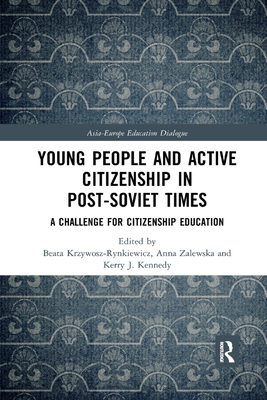
Young People and Active Citizenship in Post-Soviet Times: A Challenge for Citizenship Education
Situated within the context of "post-soviet times", this book explores young people's citizenship activities and values in three distinct environments: post-soviet union countries, post-soviet union satellites, and countries that were independent of the soviet-union. Its purpose is to investigate the influence of these contexts on the ways young people see their citizenship in what are now emerging democracies.

$69.33
Situated within the context of "post-soviet times", this book explores young people's citizenship activities and values in three distinct environments: post-soviet union countries, post-soviet union satellites, and countries that were independent of the soviet-union. Its purpose is to investigate the influence of these contexts on the ways young people see their citizenship in what are now emerging democracies.
The future of nations depends to a large extent on whether citizens will continue to support existing values and will engage in activities to support those values. Using a framework designed by Kennedy (2006) and further developed by Zalewska, Krzywosz-Rynkiewicz (2011) the study examined the citizenship values of 3794 students aged 11-14-18 from 11 European countries. The main themes of this book include
exploring similarities and differences in citizenship activities within countries and across countries;
advancing explanations for these similarities and differences;
highlighting the importance of contexts that influence citizenship activities and values; and
assessing the extent to which democratic values are reflected in young people's citizenship activities.
REVIEWS
No product reviews yet.