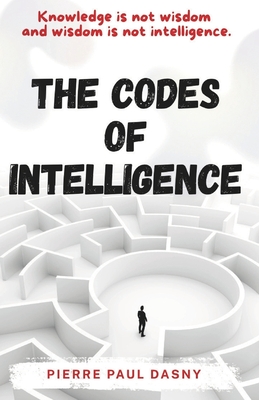
The Codes of Intelligence: Knowledge is not wisdom and wisdom is not intelligence.
What is the value of knowing a great deal if, when the decisive moment arrives, you do not know what to choose?

$26.05
What is the value of knowing a great deal if, when the decisive moment arrives, you do not know what to choose?
You can know the law and use it unjustly. You can possess information without understanding it. You can act skillfully while pursuing a destructive purpose. You can also have good intentions and produce consequences you never examined.
THE CODES OF INTELLIGENCE is a nonfiction work about critical thinking, self-discipline, behavior, responsibility, and practical intelligence. It does not present intelligence as a collection of facts, a score, or a promise of success. It examines intelligence where it is truly tested: in what you desire, avoid, reflect on, control, and defend; in the means you use; in the limits you accept; and in the consequences you leave in your own life and the lives of others.
Knowledge is not wisdom and wisdom is not intelligence.
In these pages, I present an original architecture for understanding how five effects-knowledge, law, intelligence, wisdom, and principles-operate, and how conduct can be directed through five behavioral products: Desire, Avoid, Reflect, Control, and Defend.
This book will help you: distinguish among knowledge, intelligence, and wisdom without confusing their functions;recognize how an orientation can produce an action, an omission, a decision, or a sustained disposition;identify the three wills-absolute, permissive, and relative-and understand how they modify commitment;distinguish bounded and open-ended behavioral products and detect when a goal begins to expand without a criterion of sufficiency or a condition for closure;recognize identifiable elements and elements that remain unidentified within a choice;separate facts, interpretations, predictions, and uncertainty;distinguish control, influence, authority, domination, and coercion;examine direct, indirect, immediate, delayed, intended, unintended, and transferred consequences;evaluate how a personal decision can affect a family, an institution, a community, or a digital environment;apply a practical protocol for choosing, executing, observing, correcting, and closing.
This is not a quick-fix motivational manual or a collection of feel-good phrases. Nor does it promise to eliminate error, conflict, loss, or uncertainty. It proposes something more demanding: preventing a reaction from being called a choice before it has been examined.
In an age dominated by information overload, social pressure, manipulation of language, data exposure, and decisions accelerated by digital environments, thinking is not enough. We must discern what to do with what we know, which limits we must not negotiate, what price we are making others pay, and what responsibility we will accept after acting.
The question is not merely whether you are intelligent.
The question is: What governs your life before you call what happened a choice?
REVIEWS
No product reviews yet.