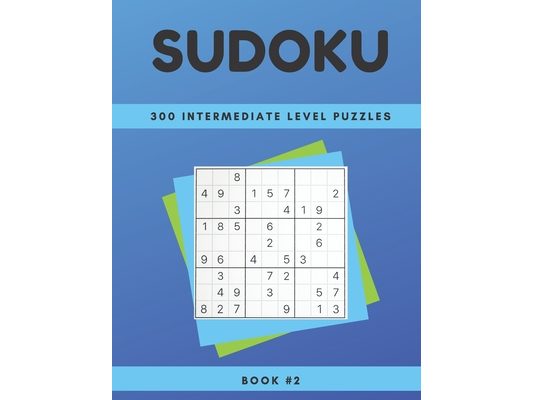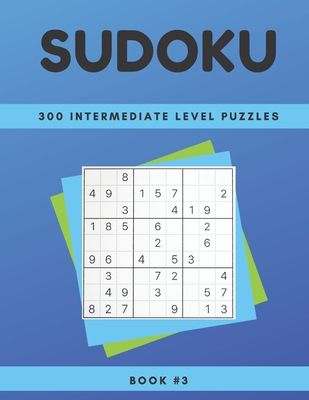
Sudoku: 300 Intermediate level puzzles 8.5 x 11 book# 3
Number puzzles appeared in newspapers in the late 19th century, when French puzzle setters began experimenting with removing numbers from magic squares. Le Siècle, a Paris daily, published a partially completed 9×9 magic square with 3×3 subsquares on November 19, 1892.[7] It was not a Sudoku because it contained double-digit numbers and required arithmetic rather than logic to solve, but it shared key characteristics: each row, column and subsquare added up to the same number.

$7.82
OVERVIEW
Number puzzles appeared in newspapers in the late 19th century, when French puzzle setters began experimenting with removing numbers from magic squares. Le Siècle, a Paris daily, published a partially completed 9×9 magic square with 3×3 subsquares on November 19, 1892.[7] It was not a Sudoku because it contained double-digit numbers and required arithmetic rather than logic to solve, but it shared key characteristics: each row, column and subsquare added up to the same number.
On July 6, 1895, Le Siècle's rival, La France, refined the puzzle so that it was almost a modern Sudoku and named it carré magique diabolique ('evil magic square'). It simplified the 9×9 magic square puzzle so that each row, column, and broken diagonals contained only the numbers 1-9, but did not mark the subsquares. Although they are unmarked, each 3×3 subsquare does indeed comprise the numbers 1-9 and the additional constraint on the broken diagonals leads to only one solution.[8]
These weekly puzzles were a feature of French newspapers such as L'Écho de Paris for about a decade, but disappeared about the time of World War I.[9]
Resource type
- books
Learning context
- for all
Activity type
- independent work
Learning environment
- on campus
- at home
REVIEWS
No product reviews yet.