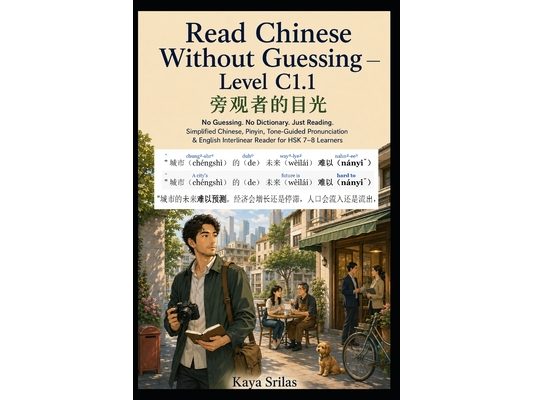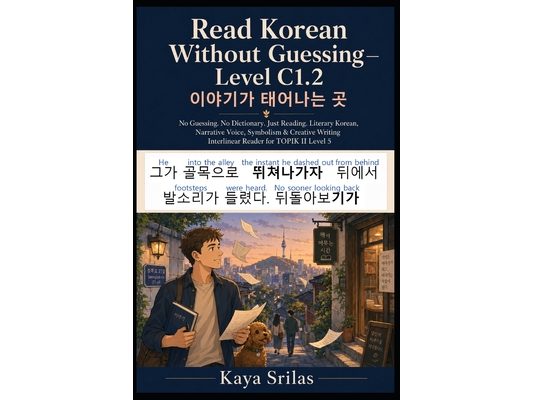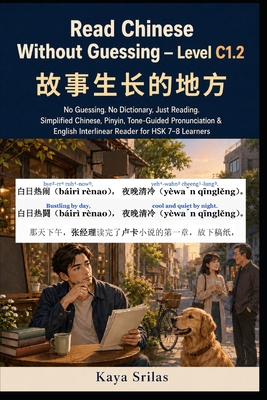
Read Chinese Without Guessing - Level C1.2: 故事生长的地方 - No Guessing. No Dictionary. Just Reading. Simpl
Read Chinese as Literature-Without Guessing

$39.25
Read Chinese as Literature-Without Guessing
Stories grow where memory, imagination, and language meet. In Read Chinese Without Guessing - Level C1.2: 故事生长的地方, Lucas leaves essays behind and begins his first novel. As people and places become fiction, you learn how advanced Chinese prose creates rhythm, atmosphere, emotion, and meaning beyond words.From Correct Chinese to Literary Chinese
C1.1 taught the language of argument. C1.2 teaches the language of art.
Across ten chapters, explore comparison, personification, balanced clauses, classical echoes, tempo, viewpoint, symbolism, and the art of the unsaid.Read With Full Support-Then Read Like a Native
Every story first appears in a complete interlinear format: Simplified Chinese characters with standard pinyinTone-guided English respelling above each wordNatural English meaning directly below
The Chinese-only version presents the same passage as authentic literary prose. At C1.2, the pinyin fade is complete: almost everything stands alone, as in a published novel.
No guessing. No dictionary. Just reading.Master the Language of Fiction
You will learn how literary Chinese moves across registers and creates effect through: Figurative comparison: 如、似、犹如、宛如、仿佛、恍若Personification: giving the world human lifeParallelism: 对仗、排比, and four-character rhythmHeld contradiction: 明明...却、一面...一面、虽...犹Classical traces: 也、矣、焉、哉、莫、未 and literary allusionHeightened emotion: 不禁、不胜、无比、至极、莫名Narrative craft: tempo, viewpoint, interior monologue, and subject-droppingImplication: 留白、意境、含蓄、言外之意A Story About Becoming a Storyteller
Lucas is an essayist-but fiction demands something different. Editor Lin guides the manuscript; Manager Zhang becomes its first critic; Xiaoyu enters as a character; and Mr. Wang stands at its emotional center. Streets, photographs, cafés, and memories become art.
It asks: How much of any story is true?Ten Chapters, One Literary Journey城市如同生灵 - simile and metaphor风抚过小城 - personification and suspended action对仗之美 - balanced lines and literary rhythm明明知道,却不说 - inner conflict and contradiction逝者如斯 - classical particles and 典故不禁泪下 - heightened emotion门一开,他便冲了出去 - narrative speed and instantaneity以谁的眼睛去看 - voice and point of view未曾说出的话 - symbolism, implication, and silence故事的开始 - Lucas completes his first novelBuilt for Independent Study
Each chapter includes an interlinear story, clean Chinese text, HSK-style questions, vocabulary practice, useful expressions, one literary focus, writing tasks, and answers.
Nine appendices cover literary devices, the simile scale, parallelism, classical particles, emotion, narrative craft, vocabulary, reading strategy, tones, pinyin, and characters.Who This Book Is For
Ideal for learners who completed C1.1 or already read advanced formal Chinese and want fiction, literary essays, and sophisticated prose. Designed for HSK 7-8 learners progressing toward C2.
By the end, your reading vocabulary reaches roughly 8,000-10,000 words from about 2,600 characters. You will hear rhythm, recognize classical resonance, follow perspective, and understand what a writer leaves unsaid.The Final Step Into Literature
Ten books ag
REVIEWS
No product reviews yet.