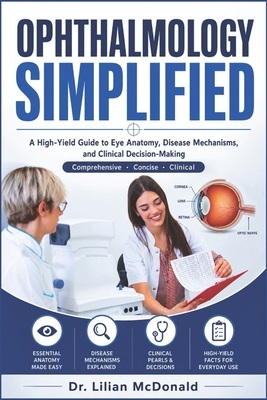
Ophthalmology Simplified: A High-Yield Guide to Eye Anatomy, Disease Mechanisms, and Clinical Decision-Making
See clearly. Think clearly. Act decisively.

$18.01
See clearly. Think clearly. Act decisively.
Ophthalmology is often taught as fragments-lists to memorize, diagrams to label, conditions to recall under pressure. But in practice, the eye does not present itself in fragments. It presents as a problem that must be understood, interpreted, and solved.
Ophthalmology Simplified was written for that reality.
This is not a handbook of disconnected facts, and it is not an encyclopedic reference you will never finish. It is a structured, clinically grounded guide that follows the way real understanding develops: from anatomy, to mechanism, to decision-making.
You begin with the architecture of the eye-because nothing in disease makes sense without structure. You move through physiology and pathology-not as isolated topics, but as processes that explain why patients present the way they do. And you arrive where it matters most: how to think at the point of care, when the diagnosis is not yet obvious and the stakes are real.
Inside, you will find:
Clear, deeply explained foundations that make complex concepts stay with you
Disease mechanisms that replace memorization with understanding
Clinical frameworks for approaching red eye, visual loss, diplopia, and emergencies
High-yield tables, comparisons, and summaries that reinforce-not replace-thinking
A seamless bridge between theory and real clinical reasoning
Every chapter is written with intention: not rushed, not diluted, and not reduced to bullet points that leave you guessing. The goal is not just to help you pass exams, but to help you see-to recognize patterns, understand mechanisms, and make confident decisions when it counts.
This book is for:
Medical students who want clarity instead of overload
Residents preparing for exams without losing clinical perspective
Practicing clinicians revisiting ophthalmology with purpose
The eye is unlike any other organ-it reveals the nervous system, the vasculature, and systemic disease in a single glance. To examine it well is to understand far more than vision alone.
This book teaches you how to do that.
REVIEWS
No product reviews yet.