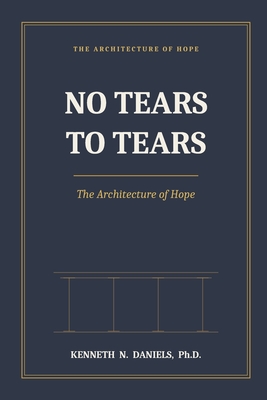
No Tears to Tears: The Architecture of Hope
Hope is not a feeling. Hope is a structure -- and it can be built.

$26.51
Hope is not a feeling. Hope is a structure -- and it can be built. No Tears to Tears: The Architecture of Hope is the story of three generations of builders -- a grandmother who built financial independence in Camden and Philadelphia when America's every institution was arranged to prevent her from doing so; a mother who took what that grandmother built and raised four sons with it in East Orange, New Jersey; and a son who spent fifty years studying institutions, serving communities, and surviving his own collapse before understanding what his family had been doing all along. That grandmother -- Priscilla M. Cooper, the woman her community called the Madam C.J. Walker of Philadelphia -- is the headwater of this book. She raised two sons who would become, respectively, one of the first Black principals in the state of New Jersey and a saxophonist in the Illinois Jacquet Big Band. Her daughter-in-law, Gwendolyn Mozetta Daniels, left Luray, Virginia as a farm girl and became valedictorian of the Bordentown School -- the Tuskegee of the North -- and then built hope into four boys in circumstances that gave her every reason to abandon it. What these women built was not luck, and it was not sentiment. It was architecture. Drawing on theology, psychology, community development, and his own hard-won journey through what he calls the "No Tears space" -- the survival mode where numbness becomes the only protection against a world determined to break you -- Dr. Kenneth N. Daniels, Ph.D. presents the Architecture of Hope as a five-pillar framework that any individual, family, or community can build: Capital: The accumulated resources -- financial, social, and spiritual -- that one generation builds and passes to the next. Mentorship: The intentional investment of knowledge, standards, and vision in those who come after. Trust: The daily practice of reliability that makes communities and institutions possible. Succession: The preparation of the next generation to carry what the current generation has built. Accountability: The personal standard -- internalized, not imposed -- that holds the architecture together. No Tears to Tears moves from scripture to sociology, from the theology of hope in the Hebrew Bible and the New Testament to the neuroscience of learned helplessness, from the history of the Bordentown School and the mutual aid societies of the Black church to the digital divide that now threatens to make the Architecture of Hope harder to build for those who need it most. It examines hope at the individual level, the family level, the community level, and the institutional level -- and it provides, in its final chapters, a practical blueprint for building hope wherever you are. This is a book for the Black community -- because the Black community has been building the Architecture of Hope for four centuries, often under conditions that should have made hope impossible, and that story deserves to be named and honored. But it is also a book for the veteran who came home to find no new mission waiting, the worker who applied to a hundred jobs and heard nothing, the single mother holding a family together with insufficient resources and unlimited determination, and the young person who looks at the world and wonders if there is any point in trying. The tears came back for Dr. Daniels -- not because circumstances improved, but because the architecture his mother had built was stronger than the forces trying to tear it down. The wells had seemed dry. The infrastructure was still there. Read it. Use it. Build with it.
REVIEWS
No product reviews yet.