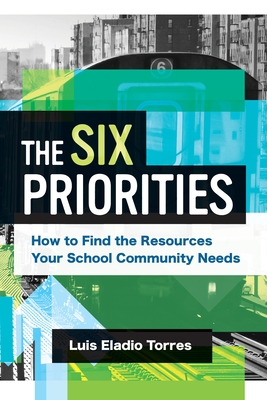
The Six Priorities: How to Find the Resources Your School Community Needs
In this provocative and timely book, Luis Eladio Torres challenges a common assumption: that education is the first priority for families, including those who are raising their children in low-income, high-need communities. Instead, he argues that these families must confront daunting challenges in five other areas--food, shelter, safety, health, and access to technology--before they can focus on their children's education.

$21.39
In this provocative and timely book, Luis Eladio Torres challenges a common assumption: that education is the first priority for families, including those who are raising their children in low-income, high-need communities. Instead, he argues that these families must confront daunting challenges in five other areas--food, shelter, safety, health, and access to technology--before they can focus on their children's education.
To make his case, Torres draws on his experience as the award-winning principal of an elementary school in the Bronx and as a leader in New York City's community schools network. A community school focuses on educating the whole child, supporting families, and extending its reach into the larger community--both by tapping into resources the community can offer and by providing a range of social and health services to that community.
The Six Priorities: How to Find the Resources Your School Community Needs demonstrates how leaders in challenging education environments can improve their schools through a community-matching process that consists of four steps:
- Identifying the gaps between what is available and what is necessary for a school and its community to function well
- Specifying needs, including prioritizing and distinguishing needs from wants.
- Telling your story, as a way to gain support for the effort to close the gap and address the needs.
- Establishing strategic partnerships with individuals, organizations, and agencies that can provide resources and expertise.
To help you implement the process in your own school, this insightful guide includes a downloadable community-matching worksheet.
The goals of this process are clear: to reduce the shocking inequities between impoverished communities and their wealthier counterparts; to help disadvantaged students succeed; and, ultimately, to steer them toward productive lives beyond the classroom. The need has never been greater.
REVIEWS
No product reviews yet.